


👋 Hey there, I’m Lenny. Each week, I share deeply researched product, growth, and career advice. For more: Lenny’s Podcast | Lennybot | How I AI | Become an AI-Native Builder and other favorite AI/PM courses
P.S. Get a full free year of Cursor, Notion, Replit, Lovable, Factory, Wispr Flow, Linear, ElevenLabs, PostHog, Brain.fm, Waking Up, and more, by becoming an Insider subscriber (while supplies last). Learn more.
Molly Graham’s first guest post, The Waterline Model, quickly rose to be my 7th most popular post of all time—extra impressive for not being about AI. I suspect this post will rise even faster.
Below, Molly introduces the concept of emergence as an alternative to conventional career advice. What she describes is exactly what my career path has looked like, and it’s a pattern I’ve seen across most of the successful people I know. If you’re worried about not having a plan for your career, or if your plan isn’t going according to plan, you’ll feel better after reading this post.
If you’re not familiar with Molly, she’s . . . incredible. She was an early employee at Google and Facebook, COO at Quip (working closely with Bret Taylor), helped build the Chan Zuckerberg Initiative (working closely with Priscilla Chan and Mark Zuckerberg), co-founder of Glue Club, co-founder of The Guild, and most recently, host of TED’s WorkLife podcast (taking over for Adam Grant). At 22, she was leading 75-day wilderness expeditions in Patagonia and Alaska for the National Outdoor Leadership School. Tl;dr, she’s seen and done a lot.
Let’s get into it.
Sheryl Sandberg once told me that everyone should have a two-year plan and a 20-year plan. The first, I could figure out; 20 always looked fuzzy.
I’ve never had a career plan. And I’ve always felt a little broken because of it.
We’re taught that careers should look like a set of stairs—you decide where you want to end up and march upward. When you look at many successful people, their careers can often appear like that from the outside.
My resume includes jobs at some big-name companies, C-level titles, and fun-looking solo ventures, but I have always wondered if it suffered from lack of design or clear destination in mind. At times, it has felt more like a game of chutes and ladders than any kind of stairs.
But recently, a conversation with Mark Rober completely changed how I think about my career. Don’t know Mark? Ask any 8-year-old who he is. He is one of the most popular creators on YouTube—76 million followers, 16 billion views—and he’s built that audience by making science genuinely fun and accessible. He’s put out one video a month on YouTube for 15 years, with remarkable consistency.
I asked him how he’s stayed grounded across a career on a platform with its own relentless pressures. Mark said he’s never had a long-term plan. Fifteen years of consistency, and none of it was by design. Instead, he has a clear set of principles that guide him, and he focuses only on the next step in front of him. And then, according to Mark, “good shit’s gonna happen.”
Then Mark introduced me to the scientific concept of emergence, a process that occurs in nature when multiple parts come together to form a complex whole without a clear plan or intention. I had a strange feeling when I heard him talk about how he trusts an emergent philosophy to guide his own career. He was describing something I’d already been doing for years, without ever having a name for it.
Emergence tells us there’s a different way to build a career: not by optimizing toward a destination but by getting really clear on your principles, learning to follow your energy, and trusting that the path will reveal itself. In some ways, an emergent career is harder to manage than having a plan and staying loyal to it. There are moments of real uncertainty, and stretches where you can’t see where you’re going. But all of that uncertainty (and all of that faith) is exactly what creates room for the opportunities you couldn’t have seen coming—which, in my experience, are the ones that matter most to a career that works for you.
Emergence can look like magic
A murmuration of starlings—thousands of birds moving together in those wild, shape-shifting clouds you see in videos—has no choreographer. Each bird follows three simple rules: stay close to your neighbors, don’t collide, and move in the same general direction. That’s it. From those three rules, something breathtaking appears. An outcome no single bird designed or planned.
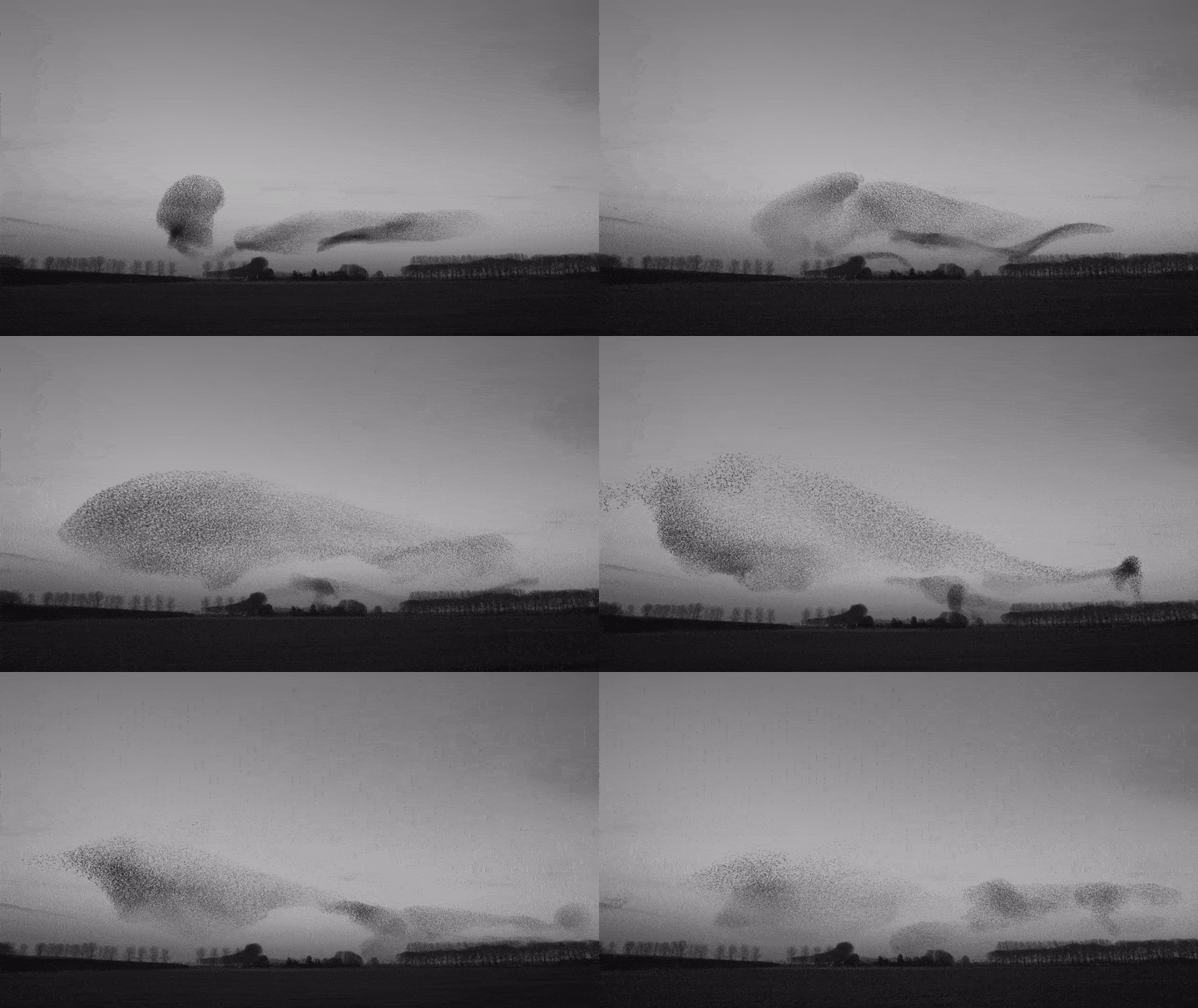
Same with a beehive. No bee has the blueprint for the colony. Each bee just follows its local rules—tend the larvae, forage for pollen, respond to signals. But the colony as a whole can regulate its own temperature, navigate to food sources miles away, and survive for decades. A single ant isn’t intelligent in any impressive way. Yet an ant colony can find food, build bridges, regulate temperature, wage war, and adapt to changes in its environment. That capability doesn’t exist in any one of them; it only comes together in the colony as a whole.
That’s the strange magic of emergence: the whole becomes capable of things that are completely invisible at the level of the parts. Emergence is what happens when simple, consistent principles—applied locally, over time—produce something complex and beautiful that couldn’t have been predicted or designed in advance.
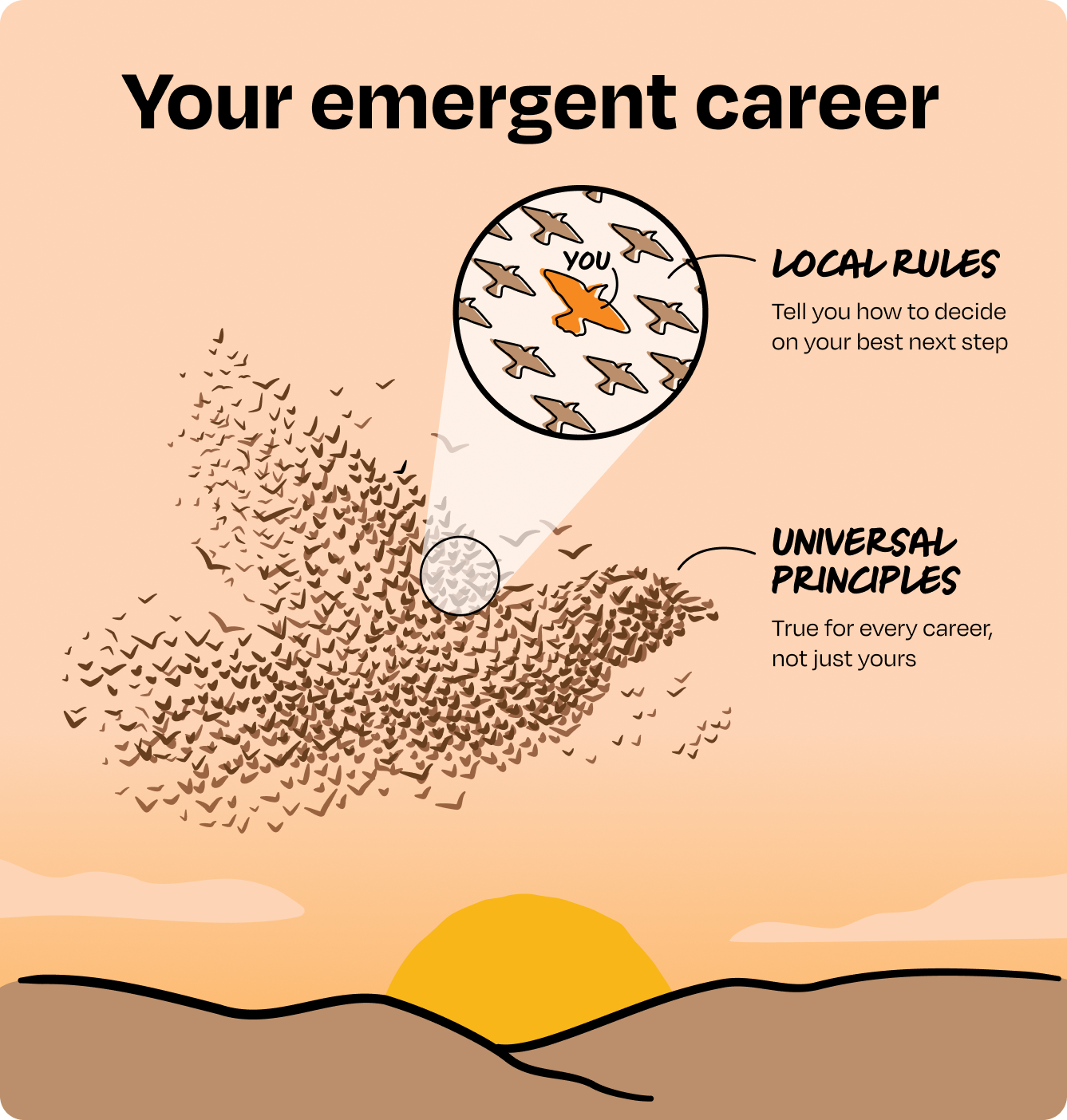
In an emergent career, you are both the individual bird and the whole murmuration—the one following the rules and the one becoming something those rules couldn’t have predicted. Every decision you make, every person you work with, every risk you take or don’t take—those are your local rules in action. You can’t see the pattern they’re creating from inside it. You can only see the next step. Yet over time, something emerges. A body of work, a reputation. Something that looks, in retrospect, like it was designed, even though no single decision along the way felt like a plan.
My whole career has been example after example of the power of emergence, but I’ll give you the best one, which is also the most recent. I stepped off the traditional career path four years ago with no plan. I simply started saying no to the jobs I was known for—COO roles at bigger and more impressive companies—because they no longer brought me joy. It was scary, and it felt necessary. I explored a bunch of different paths and worked hard to learn to listen to the parts of myself other than my ego. It was hard. I felt exhausted and confused a lot, particularly when someone offered me some new fancy job I knew I’d be great at. My ego really, really wanted to say yes. I kept saying no.
I built the leadership communities Glue Club and The Guild. I wrote on LinkedIn and Substack. Not because I had a vision for what any of this could become or because any of it made sense to anyone else, but because they made me happy every day. I was learning, working with people I loved, and having the kind of impact that mattered to me. All of it brought me energy, and I was committed to focusing on that compass. That said, more than any other time in my career, I felt like I was walking through a dark tunnel, with no sense of where I was going. Every magical moment in my career has been entangled with periods of confusion, discomfort, and darkness.
Then TED asked me to give a talk, and I said yes because I was excited about what I would learn and how I could connect with people through the talk. It felt a little random at the time but turned out to matter more than I expected. Someone on my team said, “I think this might be the beginning of something.” I said, “I just want the talk to be good.”
A year after my talk came out, TED came back and asked me to take over WorkLife, the podcast that TED and Adam Grant had spent seven years building. When they made that offer, it was like someone had turned the lights on in the tunnel. They saw me in a way that I could not see myself. That offer transformed my weird, disconnected pile of projects into a whole that felt like magic.
When I’ve talked to successful people about their own career path, almost all of them have a story that sounds like emergence.
As an example, I asked my friend Claire Hughes Johnson, the former COO of Stripe, about how she’s made career decisions and how she thinks about her life’s work. On paper, Claire’s path—politics, to senior operations and product leadership at Google, to COO of Stripe—looks very methodical and designed. But in conversation, she makes it clear that she never had a plan and was just focused on the right next step:
“Am I learning? Am I motivated? Am I in the right job? Is this the right impact? Is this what I want to be doing? . . . I think some people look [at my career] and they’re like, oh, you charted this course of success.
No, I was kind of unsatisfied, and just kept trying to find the thing . . . I don’t feel like I will figure out what my life’s work is. It will end up being the work that I did.”
It’s pretty weird to hear someone as successful as Claire say, even at this point in her career, that she doesn’t know what her life’s work is. But it honestly made me feel less crazy. As Claire explains it, she has two principles—she wants to learn and have a significant impact—and focuses on making the best next decision based on those.
To embrace emergence in your career, you have to do exactly what Claire does. You have to push past the traditional questions “How do I get where I want to go?” or “What is my life’s work?” and focus instead on asking, “What’s the right next step for someone with my principles, my energy, my values?”
That can be a harder question: Knowing your principles requires knowing yourself. Taking the next step in line with them often requires risk. You must tolerate uncertainty and real discomfort. You have to bet on yourself and have faith that the path will reveal itself.
After reflecting on my own experiences and hearing so many stories from brilliant successful people through WorkLife, I’ve come to believe that the two keys to an emergent career are defining (and redefining) your own local rules to help you make the next best decision, and following a few universal principles that increase the likelihood of career magic.
And then releasing control and having faith that those two frameworks will lead you to where you’re supposed to be.
Establish your own local rules for work
Developing your local rules that guide how you make decisions requires listening to yourself and the data you collect over the days, months, and years of work. The ongoing challenge of an emergent career is honing and evolving those rules over time and experience.
I didn’t go looking to prove this theory. I stumbled on it by asking successful people how they made decisions. When they answered, they all offered up their own principles as guiding forces.
Rules help you take the right next step
Mark Rober’s local rules are: focus on content that teaches, not just entertains; quality over quantity always; and sustainability over everything. He talked about how each of these have helped him decide when to grow his company and when to ignore the YouTube algorithm’s demand for daily posts.
Claire Hughes Johnson told me her compass has always been two words: learning and impact. If a decision gives her both, she moves toward it. If it doesn’t, she doesn’t.
One of my greatest mentors, Patty Stonesifer—an early executive at Microsoft, the first CEO of the Gates Foundation, and one of the first independent board members of Amazon—described four principles that she articulates in a mission statement: love and be loved, seek justice, learn, and laugh. She uses them to evaluate how she spends her time (she literally has a monthly worksheet she prints out to plan and evaluate her time against her principles).
Adam Grant, the organizational psychologist, has three. He talked about the principles that guide how he chooses which book to write next on WorkLife, but in a follow-up email, he crystallized his career decision principles down to: interest (“Will I wake up in the morning excited about it?”), importance (“Does it align with my values?”), and impact (“Can I make a unique contribution?”).
While writing this post, I asked Lenny what his are, and he said: follow my energy, keep the quality bar high, and be useful.
Mine, for the early part of my career, were three things: learning, people, and mission. I thought of it as a three-legged stool.
Learning, for me, didn’t mean a little learning—it meant a curve so steep I was terrified. I get energy from being in over my head. People meant I needed to be surrounded by people I was excited to learn from. And mission meant I needed to feel like the problem I was working on actually mattered and that I personally wanted to devote my time and energy to solving it. Not every important problem is the right one for me.
The point of these rules is to guide your personal decision-making. When presented with two choices, how do you decide what the right next step is? How do you explain why something that might feel so right to someone else feels wrong for you?
When Bret Taylor asked me to join him at Quip and help figure out the business, I ran it through my principles almost instinctively. Learning? Terrifying amounts of it—I’d never built a SaaS business, never done sales or marketing before. People? Bret is someone I was excited to keep learning from, and I knew he’d assemble an extraordinary team. Mission? Well, productivity software for teams didn’t feel especially meaningful to me—my stool had one wobbly leg—but I felt that the other two were so strong that it didn’t matter. I went in with my eyes open about why I was there and placed a bet based on my principles.
Your rules will evolve
My local rules have changed over time—what I needed from work at 30 was different from what I needed at 40—and almost everyone’s do. Sometimes career decisions help you discover a rule (or a nuance of a rule) that you didn’t know was so important to you. That happened to Patty Stonesifer in the middle of her career. After leaving a senior executive role at Microsoft, she accepted a senior position at DreamWorks because it sounded cool. But about three months in, Bill and Melinda Gates approached her with the opportunity to help create and build the Gates Foundation, and she realized that at DreamWorks she was missing some pieces that were really important to her. That gut check led her to create her mission statement and articulate her “seek justice” pillar.
In that WorkLife conversation, she also shared that her enthusiasm for learning, one of her principles, can overpower everything and, like my wobbly stool legs, she’s had to think about ensuring that there is the right balance across the different principles to not let one of them guide all the decisions.
For me, the only principle that hasn’t changed at all is learning. I still need to be terrified or I’m bored. But I’ve gotten much more clear on the impact that matters to me, and the people leg of my principles has gotten more specific—I need people I look forward to working with every day, people who see me clearly, and people I can clearly unlock. I’ve added some new rules too, like “seek joy,” which wasn’t a priority for me earlier in my career. These days, loving my hours and days is one of the main ways I measure my overall career satisfaction.
How do you figure out your local rules?
The most powerful signal I’ve found for defining your own local rules is your energy. Not your ambitions, not what looks good on paper, not what your parents think—what work energizes you. The question to ask is “What actually lights me up today?” not “What should I want?”
There are a bunch of exercises out there that can help you do this. Here are two that have been really useful to me:
Spend a week scoring your energy after every part of your day. For many of us, this can be broken down into 30- or 60-minute segments like meetings or work blocks. At the end of the day, sit down and score each 30-minute block on a scale from 1 to 10. My coach, Maggie Hensle, had me do this when I was at a lost moment in one job, and it came back all 1s and 10s. My day was filled with an almost equal amount of work that lit me up and work that made me want to bash my head against the wall. But most importantly, when I really dissected the 10s, I realized that the best work for me was coaching, mentoring, sponsoring, and connecting with people. It was an important insight that indirectly led me to the community work that I do now.
Identify your peak moments. Whenever I am trying to understand the work that lights people up, I ask them a series of questions: “Looking back over the past three to five years, what are three key moments when you felt like you were at your best? What are the work moments you are proudest of over those years? When you think about activities where the time flew by or you felt like you could have kept going forever, what were they?” Questions like these help you describe the type of work that excites you and brings out the best in you. The ideal way to do this exercise is with a coach or a best friend—someone who is rooting for you and will hear the patterns when you describe your answers. That person can share back with you some of the words or themes that come up over and over again.
Whatever exercise you choose, you are looking for patterns. Those patterns are your local rules in disguise.
Increase your surface area for magic
Knowing your local rules tells you how to decide on your best next step. But the truth is that there are also universal principles that increase the odds of magic. These behaviors and actions are not a plan. Instead, they’re creating the conditions for “good shit” to happen (to borrow Mark Rober’s words). And without them, you’re probably leaving a lot of magic on the table.
