

The new inner game: Your unfair advantage in the age of AI
A playbook for the biggest upheaval of work we’ll see in our lifetime

👋 Hey there, I’m Lenny. Each week, I answer reader questions about building product, driving growth, and accelerating your career. For more: Lenny’s Podcast | Lennybot | How I AI | My favorite AI/PM courses, public speaking course, and interview prep copilot
P.S. Get a full free year of Google AI, Cursor, Lovable, Notion, Manus, Replit, Gamma, n8n, Canva, ElevenLabs, Factory, Wispr Flow, Fin, Supabase, Bolt, Linear, PostHog, Framer, Railway, Granola, Warp, Gumloop, Magic Patterns, Mobbin, Stripe Atlas, and ChatPRD, by becoming an Insider subscriber. Yes, this is for real.
Joe Hudson is one of the most sought-after executive coaches in Silicon Valley, working with influential leaders like Sam Altman (OpenAI CEO) and founders and execs across Apple, Google, X, and more. He now spends much of his time coaching the research team at OpenAI and, from that inside perspective, has observed that the skills for success in AI-forward environments aren’t the ones you’d expect. Below, Joe explains and helps you prepare for what’s ahead.
For more from Joe, check out his Substack, Leadership Newsletter, and Connection Course. You can also find him on X and LinkedIn. And don’t miss my podcast conversation with him from last year!
Almost everyone I talk to is scared of the same thing.
“I’m going to get replaced by AI.”
“I can’t keep up with how fast everything is changing.”
“I’m going to end up in the permanent underclass.”
I hear this from senior VPs at Fortune 500 companies, and I hear it from people working inside the frontier AI labs. None of these fears are unfounded. The ground really is moving. Most of what you and I have been trained to do all our lives is being commoditized in the same way machines commoditized physical labor a century ago. The traditional skills we’ve optimized for—effort and knowledge—are becoming the exact two things AI does best.
But the trouble with fear is that it’s a terrible planner. Fear creates binary thinking and false ends, and braces us for worst-case scenarios, rather than preparing us for an unknown future.
Think about all the hard conversations you’ve had with your boss or investor. You rehearsed them in the shower. You ran every way they could go sideways. Then you actually had the conversation. How many times did it go exactly as scripted? So many of those rehearsals prepared you for conversations that never happened.
That’s where most of us are right now with AI. We’re afraid and rehearsing for the wrong conversations. Meanwhile, the skills that will actually decide whether we thrive aren’t even on our radar.
I spend my weeks coaching the people building this technology at OpenAI, and the courses I teach on emotional clarity at the Art of Accomplishment are full of folks from every top frontier AI lab. I have an unusual front-row seat to what’s coming because people in these environments are already operating in the future.
What I’ve seen is that those who thrive in these AI-pilled environments can stay in difficult conversations, not turn on themselves—or each other—when things get hard, and keep going in the midst of failure.
That’s the heart of what I want to show you, and it’s the opposite of what fear pushes you toward. Your unfair advantage in the age of AI comes from emotional clarity: the ability to feel what you’re feeling without being run by it. When knowledge and effort are nearly free, emotional clarity is scarce. But luckily, it’s a skill that can be learned.
In this post, I’m going to give you ways to measure your readiness around emotional clarity and hand you the specific methods to train for future success, for yourself and for your team.
How AI is changing work: the NBA-ification of teams
AI is increasingly amplifying what one person can accomplish, which means teams will start looking less like factories and more like NBA rosters: organizations will flatten and headcount will shrink, with far more capital riding on each person and their skills.
This is already happening in AI-forward tech companies like Anthropic, Amazon, Shopify, Coinbase, and Block, which are flattening their orgs and even creating “player-coach” roles. I also watch this happen every week inside the labs.
On an NBA team (and in these labs), knowledge isn’t the moat. You don’t win with the player who’s memorized the most plays or knows the most about shooting baskets. You win based on who makes the right read with two seconds on the clock, who can stay composed when the game gets physical, and who makes everyone around them better instead of worse to play with.
The result is a drastic change in what makes a team great. Talent and chemistry have always mattered, but when each person is amplified by AI, every decision, every pivot, and every bit of friction compounds. When an individual can face hard things, they accomplish a lot. But a team that can face hard things together moves exponentially faster. How to develop those emotional skills is what the rest of this piece is about.
The new inner game: the “wisdom stack” that will set you apart
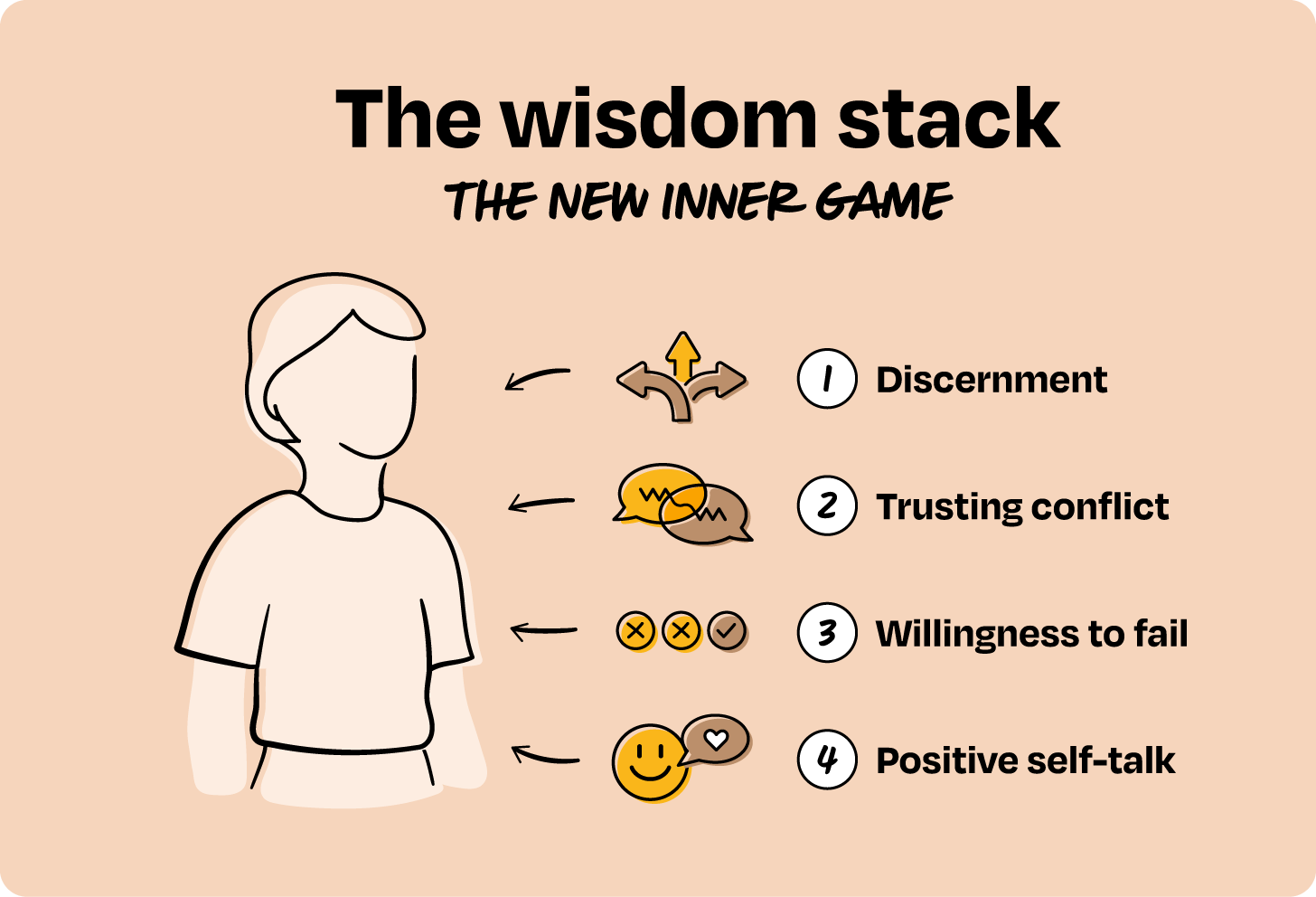
What’s pulling people ahead in the age of AI is a set of capabilities most of us never thought of as skills at all. After seeing the same qualities consistently show up inside the labs, I’ve distilled them into four traits and called them the wisdom stack:
Discernment
“In conflict we trust”
Willingness to fail
Positive self-talk
1. Discernment
As AI increasingly takes over the doing, the critical work left for humans is the higher-level deciding: what to build, what to leave behind, and when to change course.
LLMs can advise you on what decision to make, but no model can feel the subtle tension in a meeting room or register your body’s signal when something’s off. Only you have that data, and that makes discernment more valuable than ever. And what most people don’t realize is that what often degrades decision-making is a lack of emotional clarity.
You’ve probably been told that better choices come from more data or sharper reasoning, but neuroscience shows us that our choices are fundamentally emotional. Our feelings are the underlying “context-setters” on which our rational brain acts. When we avoid certain emotional states, our solution set becomes constrained in ways we may not even be aware of.
I see this play out often, even at the highest levels of leadership. It’s why some of the most brilliant, sharp leaders still make terrible decisions: they’re unconsciously dodging or grasping at an emotion, and don’t have access to the full picture.
If you’re scared of upsetting your boss, you’re less likely to have the critical conversation that could revolutionize your business. If you’re scared of technology taking your job, you’re less likely to take a big swing in an unknown field. (And by the way, AI is an unknown field, and it’ll reward those willing to take lots of big swings.)
I saw this in action a few years ago, coaching the CEO of a fast-growing company. He was generous with his people and quick to please. But the company couldn’t kill anything—every initiative lived forever, their roadmap was clogged, and teams were stretched thin. He tried to fix it with reorgs and new prioritization frameworks. Nothing worked.
I asked him when he’d last said no to something in his personal life. He went quiet. His discomfort with disappointing people had become the company’s inability to prioritize.
The constraint was emotional, not strategic. Once we worked with this fear, he started sunsetting initiatives cleanly, and his team followed. Within six months they’d cut 40% of active projects, and revenue per employee had jumped.
Do this work, and your avoidance stops running the show from the backseat. That’s the real advantage in the age of AI.
How to check your readiness: Some of the most powerful work I do with CEOs is around uncovering the unconscious emotions that end up driving critical decisions. You can try it for yourself with a practice I call the Golden Algorithm:
Name a recurring frustration in your life.
Identify the emotion underneath it (rejection, helplessness, fear of abandonment, etc.).
List the ways you try to avoid that emotion. Be specific.
List the results. In almost every case, you’ll see that the strategy you’re using to avoid the emotion is creating the exact thing you’re afraid of.
For example:
Avoid failure → Play it safe/Never take big risks → Never win big → Feel like a failure.
Avoid conflict → People-please → Constant inner conflict → Resentment builds and leads to deeper conflict.
Avoid looking incompetent → Never ask questions → Stay confused → Underperform.
Avoid disappointing others → Say yes to everything → Be spread too thin → Disappoint everyone.
How to practice:
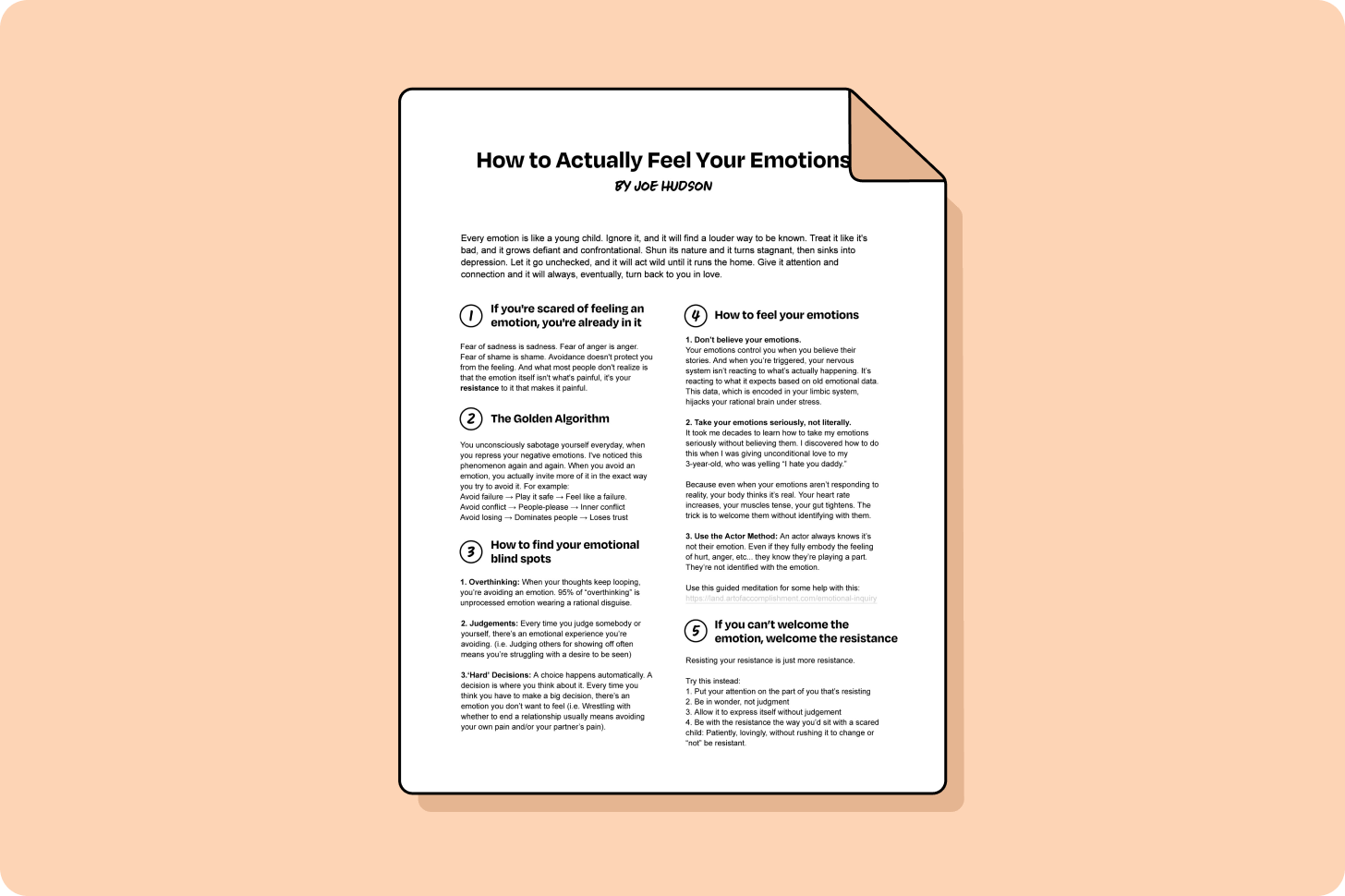
Change your relationship to your own emotional signal. Five minutes a day is enough to make a difference. Take the emotions you identified in the Golden Algorithm exercise and bring them to this practice: Emotional Inquiry.
Feel your feelings. Read and download this one-page guide.
How we do it at the Art of Accomplishment: Most people grade a decision by how it turned out—a good result means it was a good call; a bad result, a bad call. But that’s just holding yourself responsible for predicting the future, which even great investors can’t do. We treat our decisions like a portfolio, and focus instead on the process behind them.
Before a big decision, we ask ourselves: “Am I deciding to be myself and follow what I actually want, or am I trying to manage the future and avoid something I don’t want to feel?” If it’s the second one, we slow down and feel the thing first, then choose. Do that consistently and the portfolio wins, even when plenty of individual bets don’t. Every month, we also dogfood our own program, The Council, a three-hour team check-in about our biggest fears. It surfaces and resolves the biggest conversations and decisions we have been avoiding.
2. “In conflict we trust”
AI makes it easier than ever to simulate the illusion of connection. A model can draft the tough message, rehearse the conversation 10 times, and give you a perfectly worded apology. But a model cannot open you up to saying the hard thing. It cannot make you put down the position you’ve been defending. AI can hand you every answer in the world, but it can’t make you use them.
You can buy more compute. It’s a lot harder to buy your way out of the conversations your team is avoiding. Like the CEO who’s too scared to tell his employees the truth, so the decision festers for months. It’s the two co-founders who stopped being honest with each other six months ago, and now route every hard conversation through a third person.
And with the NBA-ification of teams, one unresolved tension between two co-founders is no longer diluted across multiple layers in a big org. Now it’s a huge crack running through a tight roster. When each player’s leverage is critical and powerful, every broken relationship becomes that much more expensive.
As a result, being able to have productive conflict, surface difficult issues, and stay present during uncomfortable conversations is about to become staggeringly more valuable. Those who thrive in this new world move toward the difficulty instead of away, because every conflict looks like an inefficiency to be solved—and every new solution builds a stronger team bond.
I witnessed this firsthand with one of my clients, Johannes, who runs a developer-tools company (Ona, formerly Gitpod) in one of the fastest-moving corners of the AI market. His leadership team had one of the usual buried tensions: sales versus engineering.
We brought their team through an intensive two-day summit built to surface the conversations they were avoiding. Afterward Johannes told me, “Our team did six months of work in two days. Every interpersonal conflict that was standing between us just went away. The clarity we walked away with, and the business decisions we’re now able to make, are extraordinary.”
How to check your readiness: Pick your most important working relationship. Is there something true you haven’t said? How long has it gone unsaid? That number, in weeks or months, is your connection debt.
How to practice:
At the end of each week, write down two things nagging at you. Then actually call the people involved and talk about it. Hint: There’s an open, impartial approach we recommend for this called VIEW (Vulnerability, Impartiality, Empathy, Wonder). And remember, you don’t need to solve the problem before you raise it. If something isn’t working for you, just say, “Hey, something isn’t working for me,” and solve it together from there.
Twice a month, pick any important relationship (a co-founder, a partner, a manager, a friend you’ve drifted from) and ask yourself: “What’s the scary thing I’m not saying?”
How we do it at the Art of Accomplishment: We run on high transparency and no back channels. If you have a problem with someone, you bring it to them, not about them to everyone else. I also have a recurring block on my calendar dedicated to hard conversations, where I reflect on what has been nagging at me and then reach out to discuss it.
3. Willingness to fail
AI is extraordinary at what’s already known. Ask it for the best practice, the standard approach, or the analysis, and it’s faster than any of us could ever be. Now the bottleneck is how fast you can learn something new—and that requires a willingness to fail.
Almost no one thinks their way to a breakthrough in one sitting. They iterate their way there: build the thing, see what needs to improve, build the next version. The “creative genius” is just the one who took more shots faster, and learned more from each one. Think Steve Jobs, fired from the company he built and exiled for a decade. Or James Dyson, who built 5,126 vacuums that failed before one that worked. Or Michael Jordan, who missed over 9,000 shots, lost almost 300 games, and blew the game-winner 26 times.
Many of you are likely nodding along. This is the Silicon Valley bible; you’ve heard it a thousand times. But knowing this truism versus embodying it emotionally is completely different. There’s a structure in our brain called the habenula that cuts our motivation the moment it senses failure. It’s the same mechanism that stops a bear from fighting for dominance every day. Our brains beat us up before we ever try again.
That’s why true experimentation is actually quite rare. Most only iterate where it already feels safe—the A/B test, the side project, the experiment we’re fairly sure will work. Companies can build a culture of safety for bigger risks, and the best ones do. But if you’re anywhere near the bleeding edge, it won’t always feel safe to try something new. To succeed, you have to become comfortable with the feeling of failure and discover that you can move through the fear in seconds when you stop fighting it.
So the two halves work as one loop. The more reps you take, the more the threat response quiets down and failure feels like information, not threat. And the faster a team makes those reps feel normal, the more reps each person is willing to take. Team culture lowers the social cost of failing; individual practice lowers the felt cost. Each feeds the other. The fastest way to get someone comfortable with failure is to put them on a team where failed experiments are so ordinary—even celebrated—that you stop flinching.
A team that’s internalized this is Anthropic’s product team, which runs “side quests,” where anyone can spend an afternoon prototyping an idea outside the official roadmap. No approval, PRD, or alignment meeting is needed. They build the thing, ship it internally, and see what happens. If teammates keep using it the next day, and the day after that, it gets polished and released. If nobody touches it, it dies.
Rather than effort or coordination, they’ve optimized for the rate at which new ideas can hit reality and get tested.
How to check your readiness:
Look at your past month of work. How many big-swing experiments did you and your team run? We aim for about five per team member.
Each week, check in with your team and track “pace” and “spin.”
Pace is how fast you’re moving—the rate at which you’re iterating. How quickly can you build the thing, see what’s working, and start the next one? Rate it from 0% to 150%. You’re aiming for 100%. High pace is great, but a very high pace isn’t sustainable.
Spin is the hidden tax. It’s the feeling of your wheels spinning with brakes on: second-guessing, bracing before you take the shot, loops you get stuck in when failure feels like a threat rather than an opportunity for learning. Rate it from 0% to 100%. You want it under 30%.
How to practice:
Play with your job. Treat it as a series of experiments rather than mandates. Once a week, take the task you dread most and ask: “If I doubled how much I enjoyed this, what would I change?” Then ask: “What are the one or two things I could do this week that would make everything else on my list easier or irrelevant?”
Take a goal you’ve been circling. Instead of one big attempt you could “fail,” write down 20 small experiments you could run around it to learn something new. Then start running them. Each one you complete is a win, regardless of how it turns out. You’re training yourself to measure progress by iterations, not outcomes.
How we do it at the Art of Accomplishment: Everyone on our team is responsible for running five experiments every quarter to refine the way they work. These are fast and loose, and easy to measure. The important thing is the pace of trying new things and learning, not getting it right or taking weeks to design the perfect experiment. And this is true for everyone in our org, from an executive assistant to the president. We also have a “failure celebration” at our annual offsite where we present our biggest “failure.” It gets a standing ovation from the rest of the team.
4. Positive self-talk
This skill sits underneath and supports the other three, which is why it’s one of the biggest differentiators I see.
You can have all the talent in the world, but if you regularly talk to yourself in a hostile tone, that mentality makes you doubt every decision, kills your creativity, and puts you into chronic stress and overwhelm.
A study on perseverative cognition, or repetitive negative self-talk and worry, found that the body can’t tell the difference between an actual threat and a thought about a threat. When we criticize ourselves, our brain reacts as if we’re under attack. Cortisol and adrenaline spike, our heart rate climbs, and blood pressure rises. I’ve seen this affect the most creative and successful people I work with. Their biggest bottleneck is how they relate to themselves.
The internal voice of a lot of high performers is brutal: “You’re not doing enough. Why aren’t you further along? This isn’t good enough.”
In the pre-AI era, self-criticism could push you to outwork the person next to you. It hurt, but the negativity could lead to success (though eventually to burnout). That math has flipped. You can’t out-grind a server farm or outwork a model that doesn’t sleep. The voice that used to drive harder work is now just shutting down every single capability that’s a differentiator in the AI era.
The good news is that this skill is more trainable than knowledge or effort. You can’t add 50 IQ points or 20 years of experience to your resume. But your internal voice was learned, which means it can be changed. In fact, we know this because we’ve measured the impact of one of our programs for seven years: we improved negative self-talk by a full standard deviation across all participants.
How to check your readiness: For one day, treat your inner monologue as a transcript. Every time you notice yourself feeling tight, stuck, or low, stop and:
Set a 5-minute timer.
Write down exactly what’s going through your head.
Most people are stunned by what they find. The voice they’ve been listening to all day says things they would never say to a friend or their child: “That was stupid of you.” “Everyone can tell you’re faking it.” “You should have known better.” “You haven’t done enough today.” “You are an imposter.”
How to practice:
 | A guest post by
|